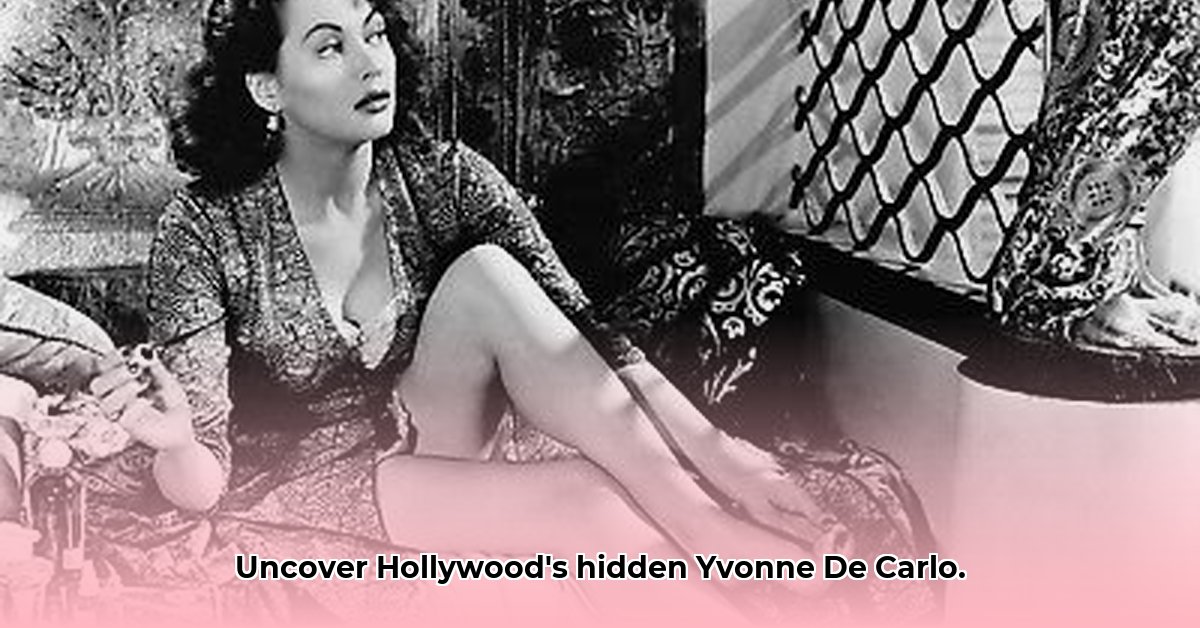
Let's delve into the life and career of Yvonne De Carlo, a name synonymous with classic Hollywood glamour. While undeniably beautiful, possessing the classic screen siren qualities that captivated audiences, her story extends far beyond mere aesthetics. Her career, spanning decades, offers a compelling case study of the challenges and triumphs faced by women in mid-20th-century Hollywood, particularly those perceived as possessing "exotic" appearances. Was she simply a product of her time, or did she actively shape her image and trajectory? This exploration seeks to answer that question.
A Genre Career: Choice or Constraint?
De Carlo starred in numerous genre films—swashbucklers, historical epics, and more—frequently cast as the alluring female lead. Her striking appearance undoubtedly contributed to this casting. But was this a strategic career move, a conscious path to stardom, or a limitation imposed upon her? Consider the roles she didn't secure. While films like Passion (1954) showcased her acting prowess, did they fully allow her to demonstrate her complete range? Analyzing her choices requires careful consideration of the available opportunities and the prevalent industry biases of the era. Did she actively navigate these limitations or was she, in part, a product of this restrictive system?
Beyond the Silver Screen: A Woman's Ambitions
De Carlo's autobiography reveals a woman with ambitions beyond simply being a beautiful face. Did she successfully transcend the "exotic beauty" stereotype? Did she receive the recognition she deserved? This is a critical question demanding thorough investigation, requiring us to consider the challenges she faced balancing her personal aspirations with the realities of the Hollywood studio system. What specific obstacles did she encounter, and how did she, both subtly and overtly, challenge the norms of her time?
Unpacking Yvonne De Carlo's Legacy: A Nuanced Perspective
Numerous resources exist to learn about De Carlo—films, biographies, interviews—but a true understanding requires deeper exploration. Analyzing contemporary reviews, comparing her experiences with those of actresses from diverse backgrounds, and examining the historical context are crucial to a well-rounded appraisal. The considerable barriers faced by women in the industry during this period must be acknowledged. Why is this approach necessary? Only by fully considering her successes and her setbacks can we truly appreciate her journey and her enduring contribution to Hollywood.
Delving Deeper: Future Research Directions
To achieve a more comprehensive understanding of De Carlo's life and career, future research should focus on:
Comparative Analysis: Comparing her career trajectory with those of other actresses from the same era and diverse backgrounds will provide crucial context. This comparative study is essential for understanding the impact of both societal biases and individual agency.
Critical Reception Analysis: A thorough examination of contemporary reviews will shed light on how critics and the public perceived her performances and image. This will reveal prevailing industry standards and critical judgments.
Archival Research: Investigating personal correspondence, production notes, and studio memos will provide invaluable behind-the-scenes insights into her career and the creative process. Unlocking this previously unavailable information will greatly enhance our understanding.
Quantitative Analysis: Gathering data on box office receipts, award nominations, and media coverage will provide quantifiable evidence of her popularity and influence. Examining such numerical data offers an objective measurement of her impact.
Through these efforts, a more complete and accurate portrait of Yvonne De Carlo will emerge—a portrait of a woman who navigated considerable obstacles while still operating within the confines of a deeply patriarchal industry. This more complete picture is essential for a proper appreciation of the complexity of her career.
How Did Yvonne De Carlo's Italian-American Heritage Influence Her Hollywood Career?
De Carlo's Italian-American heritage played a nuanced yet significant role in shaping her Hollywood career. Her striking features—dark hair, expressive eyes, and a statuesque figure—differentiated her from the predominantly blonde actresses of the time. This "exotic" quality, directly influenced by her heritage, was central to her early career, landing her roles in films such as "Salome, Where She Danced," where her Mediterranean features perfectly matched the script's requirements. However, was this a purely advantageous association?
Navigating Stereotypes and Expectations
While her heritage provided opportunities, it also potentially limited her range. The entertainment industry's tendency towards typecasting based on perceived ethnicity is well documented. While De Carlo effectively avoided strict confinement to "exotic" roles, the question remains: how might the trajectory and diversity of her career have differed without these implicit biases? Her later roles showcased her versatility, but the lingering effect of early typecasting provides a crucial point for reflection. Did she consciously and successfully overcome such stereotypical expectations?
Personal Identity in the Public Eye
How did De Carlo herself reconcile her Italian-American identity with the demands of Hollywood? Her frankness in her autobiography offers insights into this complex relationship, revealing a dynamic interplay between personal values and public image. This candidness, in turn, likely fostered strong connections with her audience. Did this honest portrayal contribute to her success, or was it simply a reflection of her own identity and personality?
From Siren to Sitcom Star: A Career Transformation
De Carlo's career wasn't linear. Her transition from glamorous roles to her iconic portrayal of Lily Munster in "The Munsters" allowed her to highlight a strikingly different facet of her personality and talent. This transformation prompts the question: Was this transition a strategic career move or a natural evolution of her multifaceted talents? The success of this transition showcases her adaptability and career resilience.
Enduring Impact and Legacy
De Carlo's career serves as a testament to both her skill and her perseverance. While the precise impact of her Italian-American heritage remains open to interpretation, its influence on her image and the types of roles offered to her is undeniable. Her story highlights the complex interplay between an individual's identity and the opportunities—and limitations—presented by the industry. Her legacy continues to inspire further investigation and offers valuable insight into the experiences of women in Hollywood.
Key Takeaways:
- De Carlo's Italian-American heritage contributed significantly to her "exotic" image and provided opportunities in specific genres.
- The inherent risk of stereotyping presented continuous challenges, requiring her to display consistent versatility.
- Her candid public persona, possibly informed by her heritage, fostered a strong connection with her fanbase, contributing to her longevity.
- Her successful transition to television comedy demonstrates her impressive adaptability and willingness to challenge preconceived notions.
⭐⭐⭐⭐☆ (4.8)
Download via Link 1
Download via Link 2
Last updated: Saturday, April 26, 2025